CSA Share Week 1 June 6, 2012

Welcome to our first blog of the 2012 CSA Season!  What a great way for mother nature to welcome me to my summer break from teaching.  The beautiful weather makes it very inviting to head out to hoe, plant or just observe.  Observe the day-to-day changes, growth, soil conditions, and also the problems like new transplants needing water or the unwelcome great crop of cucumber beetles on the squash that need addressing. Good or bad, its good to just be there. 

Your fist week basket has what grows best early in the season.  ImageIn the open bag, Mixed heirloom lettuce.  This is a collection of Forellenschluss, Red Velvet, Australian Yellowleaf, and Pablo. This lettuce is great many ways: salad, sandwiches or my favorite use, wilted. There is a simple wilted lettuce recipe below.  I could eat wilted lettuce every day this time of year.  The lettuce was tossed in some water when picked as the ground was a bit dry and hot, but is best to store without washing.  If it is washed, be sure it is dried well before refrigerating.  A papertowl in the bag is good at absorbing the excess moisture. 
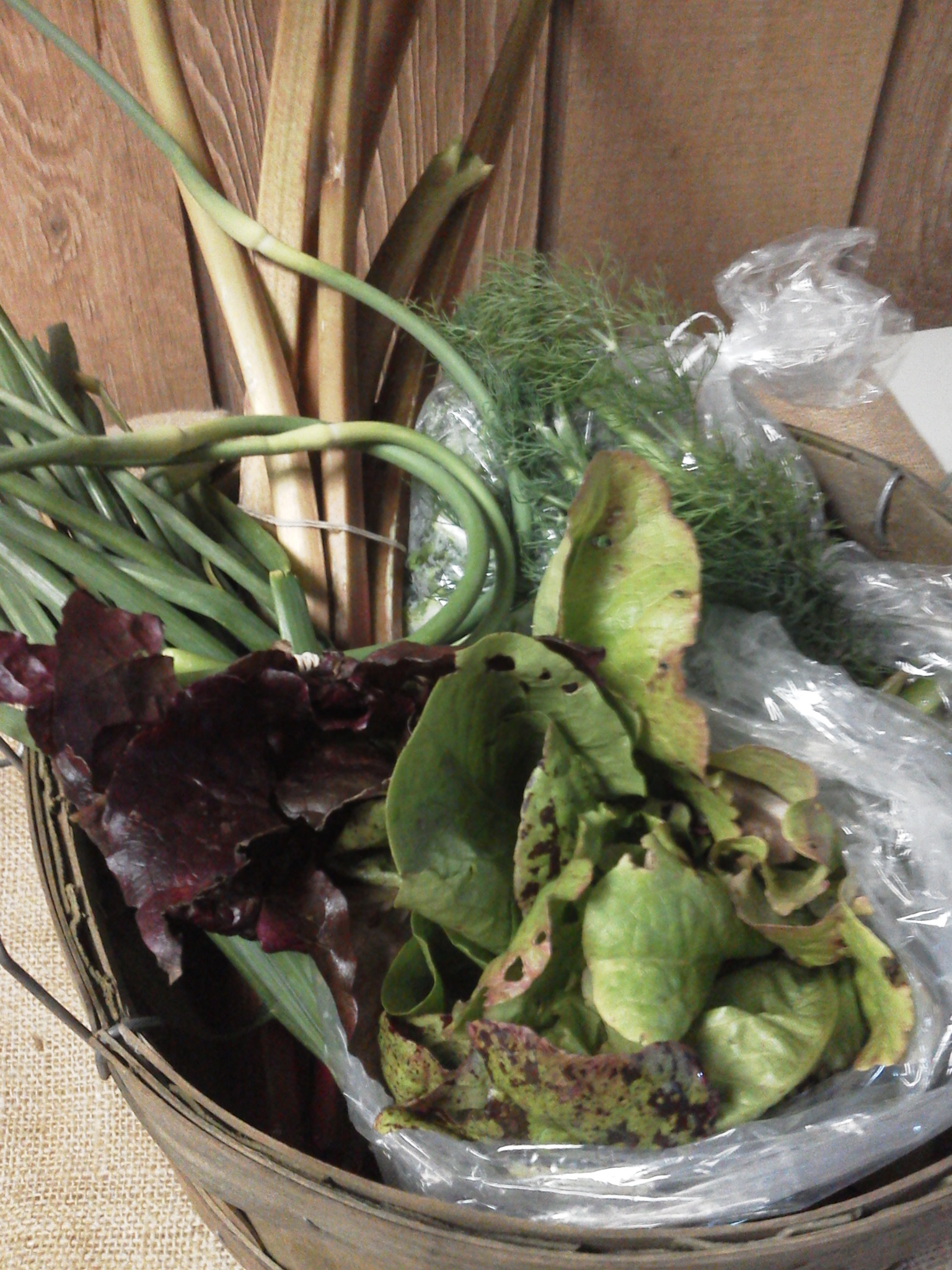
In the closed bag there is an italian spicy green mix.  This mix from Italian Seed and Tool is mix of endive, chicory, mache, arugula, and lettuce.  Some people love the spicy and bitter taste in a fresh salad such as the French Salad shown below. If the heat is too much for you, wilt it.  It takes the edge off.

Bok Choi.  Bok choi is a mild tasting green that makes an excellent base in a stir fry.  It is also fantastic braised with chicken broth, sesame oil and a little butter.

Little bundle of garlic scapes.  These are the undeveloped flowers from the hardneck garlic plants.  They can be used just as you would garlic as they have the same wonderful flavor. 

Your basket also contains some new green onions, rhubarb, a little sprig of fresh dill weed, and either sugar snap peas or asparagus. 

Finally, since it is the first week, and you may get be looking for something more substantial than greens, there is a bit of our awesome fresh chevre goat cheese.  Try it on a salad, on a pice of crusty bread with braised onions or mixed with a little honey on a cracker.  The goat cheese should last a couple of weeks in the fridge.

If you find any great ways to use any of the produce or goat cheese, feel free to share your ideas here.  Just leave a comment or link a recipe (since many are floating around the internet). 

Hope You have a great week!

French Lettuce Salad

6 to 8 servings

1/3 cup olive oil or vegetable oil
2 – tablespoons wine vinegar
1/4 teaspoon salt
1/4 teaspoon dry mustard
1/8 teaspoon pepper
10 – cups mixed greens

Shake all ingredient except greens in tightly covered jar; refrigerate. Shake before serving. Toss with greens.

Goat Cheese with Caramelized onions. 

Caramelized onions with Brandy

2 tablespoons butter
1 tablespoon olive oil
2 large onions sliced thin
Salt and pepper
1 tablespoon brandy

Over medium heat melt butter with olive oil. Add onions, season with salt and pepper.  Cook, stirring constantly until onions are soft. Add brandy and continue to cook until onions are golden brown. About 20 min.
 
Slice a baguette, drizzle with olive oil and bake at 400 unto golden brown.  Spread with got cheese and top with Caramelized onions. 

Wilted Lettuce,

This was my ma’s recipe passed on to me–don’t know any other way to make it.  This is really an old-fashioned dish.

Ingredients
1 pound leaf lettuce
4 -5 green onions
salt
pepper

Dressing

1/2 cup bacon grease

1/2 cup vinegar

1/4 cup water

1 tablespoon sugar

Directions

  1. Wash the lettuce several times; drain.
  2. Clean and cut the onions into the lettuce.
  3. Sprinkle with salt and pepper to taste.
  4. Dressing: Heat dressing ingredients to boiling; pour over lettuce while boiling hot.
  5. Stir and mix well.
  6. Serve immediately.

Apple Grafting Antique Apples

Honey Crisp, Sweet Tango, Snow Sweet and Zestar are only a few most sought after apple trees recently developed.  The crisp, sweet, flesh and crowd pleasing names command great prices at the orchard and market.  In many orchards, the old standard varieties are topworked or pulled out and replaced with these popular varieties.  However, through this process many old and unique varieties of apples may be lost for ever. 

Apples of the past harbored a multitude of colors, textures, shapes, growth habits and most importantly, taste that solidified their place in the homestead orchard. Wether it be the bright pink flesh of the Cinnamon Spice, the enormous size of the Pound Sweet or the unattractive brown russeted skin of the Golden Russet, each variety of the past had a unique feature that made for a unique use.  Looking through many apple catalogs one can find a section highlighting the use of the apple.  The uses range from good for fresh eating to sauce, cider, or long-term storage.

As the requirements of apples changed over the years due to improvements in transportation, storage and disease resistance, so did the varieties grown by orchards.  Perhaps the greatest change in the apple was the shift from a society of people who relied on apples as a preserved food source in the winter to one where many apples are eaten fresh.  However, if one looks back on the parentage of these current varieties they will often find the unfamiliar name of an old Antique Apple. 

Over 17,000 varieties of apples have been recorded, but only a few thousand are documented to still be in existence today.  Fewer than a handful are commonly available to consumers.  Many of the lost varieties were probably no big loss as they lacked the qualities of improvement over other varieties.  But many of the rare apples quite possibly are worth saving.  These varieties could be used in breeding programs or have a unique property that a certain segment of the marketplace demands.  Once a particular genetic variety is lost, it is very difficult, to resurrect it.  Herein lies the need for genetic preservation. 

Seed Savers Exchange is an organization committed to genetic preservation of rare and old varieties of fruits, vegetables, and flowers.  Each spring they offer an Apple Grafting Workshop.  At the workshop, participants have the opportunity to learn how to bench graft apple varieties taken from there preservation orchard.  If successful, they then get to take their trees home and enjoy these apples in a few years, alright more like 5 to 7 years.  Two years ago I attended this workshop and became hooked when 3 of my 4 grafted trees actually took.  A couple were damaged over the winter but I still have 1 tree that is flourishing, a variety named Hamilton.

Each year since that first class, I have spent a few nights in the late winter, grafting new varieties of apples.  The grafting process is quite simple.  One needs a few supplies such as a sharp grafting knife, rubber band, parafilm or grafting wax, a rootstock and some scionwood.  The rootstock is the bottom portion of the soon to be apple tree.  The rootstock has many functions.  It is responsible for providing the anchor of the tree.  It also can provide some disease resistance or help the tree tolerate different soil and temperature conditions.  Most commonly, the rootstock is used to dictate the size of the apple tree when mature.  Most commercially available trees are grafted onto a semi dwarfing root stock.  I purchased my rootstocks from Fedco Trees and Willamette Nurseries.  Fedco sells them in increments of 20 while Willamette sells them by the 100.    Common Rootstocksvarieties are the Malling 7, Malling 111, and Bud 118.  These rootstocks restrict the size of the tree between 50% and 80% of the standard size. Many commercial orchards use dwarfing rootstock.  This allows for easy picking, spraying, pruning and trees can be planted more densely.  I have been using semidwarfing and standard rootstocks.  Some nurseries, like St. Lawrence Nursery, only use standard rootstocks as they believe it also increases winter hardiness and longevity to the tree. Standard rootstocks do take longer to reach production and the large trees can be inconvenient to work with.  But not much is as stately as a big old 30 ‘ apple tree.    Scionwood

The most important part of the apple tree graft is the scion.  The scionwood is the specific variety of apple being grafted.  It has unique fruiting qualities that make it desirable. While searching for old apple varieties of apples I stumbled across Eastmans Antique Apples.  It is an amazing place claiming to have over 1500 varieties of apples.  They don’t typically sell trees or scionwood as they focus on growing and selling the actual apples, which I think is wonderful.  I was able to obtain 20 varieties of scionwood from them.  This year I grafted over 150 apple trees encompassing 30 named varieties and 6 unknown varieties collected from a neighboring abandoned farm. 

There are multiple grafting techniques.  The technique used depends on when the grafting is taking place and the size of the rootstock and scionwood.  I typically use a whip and tongue grafting method.  The grafting process begins by cutting the rootstock and the scion at a slant. The areas of the slants need to be similar in size and shape so the cambium layers of the two line up.  The cambium layer is the thin ring just beneath the bark and is a pale green or cream color.  This tissue is actively growing that will provide the initial vascular connection from the rootstock to the scion.  A cut is then made vertically into each of the pieces that make the tongue.  The tongue will help firmly hold the scionwood to the rootstock untill the two grow tougher with the help of callus tissue.  Callus tissue is a mass of undifferentiated tissue.  While to some it would resemble scar tissue, it is more like a mass of stem cells.  Callus TissueCallus tissue has the ability to develop into roots, shoots, or other tissue.  In a graft, the callus turns into new vascular tissue that grows the scionwood and rootstock together.  The newly formed graft is then wrapped with a rubber band for stability and grafting wax or parafilm (I use press and seal) to keep in the moisture.  The roots of the hopeful trees are then wrapped in wet newspaper or sawdust.  The trees should be placed in a cool and damp location.  I have used a refrigerator but the root cellar works better. It is important that the trees are not bumped or disturbed during their time of healing together.  During the 4 to 5 weeks the two fuse together and the buds will begin to develop.  When the buds begin to form the trees can be planted out in a convenient location were you can keep you eye on them  and water them frequently.  During the first year, never handle the trees by the scion as the connection can be easily broken.  During summer the parafilm and rubber band can be removed and it will become apparent which grafts worked.  The following spring, before bud break, the trees should be moved to their permanent location.

Some of the trees I have grafted are pretty obscure and may not be the greatest tasting for my area.  But my hope is that a few turn out to be something wonderful that others can enjoy. If there are others in the area who have scionwood they would like to trade, I would love to expand my collection of antique apples.

Compulsive Seed Purchasing

Saving heirloom seeds is rewarding, but the drawback comes during those long winter evenings when all the different varieties look so fun.  It never fails, each winter once the catalogs begin to roll in, the list of desired seeds grows beyond what I can realistically handle planting AND maintaining.  Sending orders in through the mail gives a person to write the list, compare between companies and think about it before writing the check and making the trip to the mailbox.  However, with the advent of on-line purchasing it become all to easy to ‘add to cart’. 

Restraint is needed.  The virtue of Temperance is one that many struggle with at times. Temperance not only applies to those restricting their alcohol consumption or electronic buying but also to those of us who are compulsive seed collectors.  I try to write it off as being inexpensive, healthy and useful, but really, is there a need to have 70 different varieties of tomatoes in my basement seed vault? My issue of temperance also applies to my habit of wanting to collect and raise multiple species and breeds of livestock. 

I suppose there are worse things to collect, but this time of year I need to remind myself that while these wonderful ideas look great on paper, restraint will help maintain my sanity once the gardens are planted and weed maintenance begins. 

That being said here is the current list of seeds. They all may not make it into the garden, but were going to sure try.

Beans Burgandy
Beans Dragons Tounge
Beans Edamade be sweet
Beans Garrafel Enana
Beans Golden Pencil
Beans Jade
Beans Rocquheneourt
Beans Romano Gold
Beets Albino
Beets Bulls Blood
Beets Chioggia
Beets Cylindricia
Beets Detroit 2 Bolivar
Beets Detroit Dart Red
Beets Golden Detroit
Beets Touchstone Gold
Beets Yellow Mangel
Beets  Egyptian Turnip Rooted
Broc Blue wind
Broc Early
Broc Purple sprouting
Broc Rapa
Broc Romanesco San Guiseppe
Broc  Late  
Cabbage Casumi F1 Hybrid
Cabbage Chinese Blue
Cabbage Cour Di bue
Cabbage Filderkraut Hilmar
Cabbage Kalibos
Cabbage Late Flat Dutch
Cabbage Marner Lagerrot
Cabbage Premier
Cabbage Red
Cabbage Savoy Vertus 2
Cabbage  Savoy verona
Carrot Atomic Red
Carrot Cosmic Purple
Carrot Danvers Half Long
Carrot Deep Purple
Carrot Juan du Doubs
Carrot Lunar White
Carrot Nantes Half Long
Carrot Nelson
Carrot Orange
Carrot Purple Haze
Carrot Rothchild
Carrot Solar yellow
Carrot St. Valery
Carrot Tonda de parigi
Carrot White Satin
Carrot Yellowstone
Corn Oaxacan Green Dent
Corn Tom Thumb
Cucumbers Edmonson
Cucumbers Homemade Pickles
Cucumbers Lemon
Cucumbers Marketmore 76 Slicing
Cucumbers Mini White
Cucumbers Muncher
Cucumbers Poona Kheera
Cucumbers ruby Wallace White
Cucumbers Suyo cross
Cucumbers Verde Ortolani Sensation
Eggplant Rosa Bianca
Greens Arugulla
Greens Chicory Italico roso 2
Greens Chicory Italico rosso
Greens Chicory palla rossa 3
Greens chicory variegata Di CastelFranco
Greens chinese Cabbage
Greens Cornsalad
Greens Endive
Greens Kale – Nero di Tuscana
Greens Kale – Red Russian
Greens Pak choi
Greens Salad Mix Insalata Odorosa
Greens Swiss chard lucullus
Greens Swisschard mixed
Greens  Pak choi mini
Heb Borage
Herb Basil Blue
Herb Basil Dark Opal
Herb Basil Holy Red and Green
Herb Basil Lettuceleaf
Herb Celaric Dynamite
Herb Chive Ping Giant
Herb Cilantro Slow Bolt
Herb Dill Mamoth
Herb Fennel Bronze
Herb Fennel Finale
Herb Parsley Curley
Herb Parsley Giant Italian
Herb Parsley Giant of Naples
Herb Parsley Hamburg Root
Herb  Basil Italian
Kale Flower Sprouts
Kale Red Russian
Kale  Black Tuscan
Kohlrabi Purple
Kohlrabi Superschmelz
Lettuce Centurino romaine Lettuce mix
Lettuce Crispino
Lettuce Florenchluss
Lettuce Iceberg
Lettuce Majestic Red
Lettuce Mix
Lettuce Paris White Cos
Lettuce Plato Romain
Lettuce Red Butterhead
Lettuce Romaine  
Lettuce Romaine Little Gem
Lettuce Sunsation
Lettuce Yugoslavian red
Mellon Bidwell Casaba
Mellon Chelsea
Mellon Edens Gem
Mellon Moon and Stars
Mellon Petite Yellow
Mellon Pride of WI
Mellon  Banana
Onion Borrettana
Onion Leek Bleu De Solaise
Onion Vernina
   
Onion  Cipollini Piatta di Bergama
Onion Leek Musselburgh
Onion Scalian Red
Onion  Scalian White
Pea Ho Lan Dow
Pea Oregon Sugar Pod II
Pea Snow/Sugar Oregon Giant
Pea Sugarsnap
Pea Sugarsnap
Pea  Sugar ann Snap
Pepino Garden Berry Pepino
Peppers  PinoNoir
Peppers Alma Paprika
Peppers Ancho Gigantea
Peppers Cayenne
Peppers Chervena Chushka
Peppers Cyklon
Peppers Czech Black
Peppers Feher Ozon Paprika
Peppers Flavorburst hybrid
Peppers Jalepeno
Peppers Jimmy Nardello
Peppers Joe Long Cayenne
Peppers Lemon Drop
Peppers Ace
Peppers Lilac
Peppers Merlot Hybric
Peppers Mucho Nacho
Peppers Orange Bell
Peppers Pot of Gold
Peppers Quadrato Giallo
Peppers Quadrato Rosso
Peppers Revolution
Peppers Serrano Tampiqueno
Peppers Sonoma Sunset Hybrid
Peppers Super chili hybrid
Peppers Sweet Chocolate
Peppers Sweet Gourmet
Peppers Volcano
Peppers Wisconsin Lakes
Peppers Yummy Orange
Potato All Red
Potato Austrian Crescent
Potato Kennebeck
Potato Purple Majesty
Potato Red Gold
Potato Red Norland
Potato Rose Finn
Potato Swedish Peanut
Potato Viking
Potato Yellow Finn
Potato Yukon gold
Radish cincinnati market
Radish Easter Egg
Radish Munchner Bier
Radish  German Giant
Radish Helios
Radish Plum Purple
Radish Purple Plum
Radish  White Hailstone and French breakfast
Rutabegga Generic
Spinach Bloomsdale
Spinach America
Spinach Placo F1 hybrid
Spinach Bordeaux
Spinach Melodey Hybrid
Spinach Palco
Spinach Space
Spinach Tyee
Squash Amish Pie
Squash Baby Boo
Squash Baby Hubbard Mix
Squash Birdhouse Gourd
Squash Buttercup
Squash Butternut
Squash Candy roaster
Squash Chirimen
Squash Cornfield Pumpkin
Squash Flat White Boer
Squash Galeux d’Eysines
Squash Gourd Mix
Squash Howden
Squash Jack Be Little
Squash Jarradale
Squash Long Island Cheese
Squash Lumina
Squash Marina di chioggia
Squash Musquee De Provence
Squash Pennsylvania Dutch Crookneck
Squash Rouge Vif d’etampes
Squash Silver Bell
Squash Strawberry Crown
Squash Summer Burpee Golden Zuke
Squash Summer Burpee Zuke
Squash Summer Fordhook Zuke
Squash Summer Romanesco Zuke
Squash Summer Sunburt Pattypan
Squash Summer Zucchino Rampicante
Squash Sweet Dumpling
Squash Sweet Lightning
Squash Thelma Sanders Sweet Potato
Squash Wee-Be-Little Miniature
Squash Winter Luxary Pie
Squash Zapo Plomo
Squash Zeppelin Delicata 
Squash  Boston Marrow
Squash  Sibley
Tomatillo Purple
Tomato Abraham Lincoln
Tomato Amish Paste
Tomato Amish Paste
Tomato Ananas Noire
Tomato Aunt Ruby
Tomato Basinga
Tomato Blondkopfchen
Tomato Brandyboy Hybrid
Tomato Brandywine (Sudduth’s Strain)
Tomato Brownberry
Tomato Carbon
Tomato Cherokee
Tomato Chocolate Stripes
Tomato Cold Set
Tomato Costultu Genovenese
Tomato Cream Sausage
Tomato Crnokovic Yugoslovian
Tomato Djena Lee’s Golden girl
Tomato Dr. Wyche’s Yellow
Tomato German striped 
Tomato Giant Oxheart
Tomato Goldman’s Italian American
Tomato Goliath Hybrid
Tomato Green Grape
Tomato Green Sausage
Tomato Green Zebra
tomato Italian grape
Tomato Japanese Trifele Black
   
Tomato Juane Flamme
Tomato Kellogg’s Breakfast
Tomato Kentucky Beefsteak
Tomato Kolb
Tomato Lemon Drop
Tomato Malakhitovaya Shkatulka
Tomato Master F1
Tomato Mexico Midget
Tomato Nature’sRiddle
Tomato Olpalka
Tomato Omars Lebanese
Tomato Orange Banana Paste
Tomato Park’s Whopper 
Tomato Paul Robeson
Tomato Permisson
Tomato Pineapple
Tomato Pink from Jim
Tomato Purple Russian
Tomato Riesentraube
Tomato Rosso Sicilian
Tomato San Marzano 2
Tomato San Marzano 3
Tomato Silvery Fir Tree
Tomato Speckeled Roman
Tomato Sungold
Tomato SunSugar
Tomato Super Souix
Tomato Super Suncherry Hybrid
Tomato Sweet Treats Cherry
Tomato Ultimate Opener
Tomato Velvet Red
Tomato Viva Italia Pear
Tomato Waspicion Peach
Tomato White Potato Leaf
Tomato White Queen
Tomato Wisconsin 55
Tomato Woodle Orange
Tomato Yello Mortgage Lifter
Tomato Yellow Speckled roman 
Turnip Hakurie
Turnip  Scarlet Red Queen
Parsnip Mitra
Swiss Chard Deluxe Rainbow Mix
Cauliflower Graffiti F1 hybrid
Cauliflower Early Tuscan

Welcome to Chatham Preservation Farm

Welcome to Chatham Preservation Farm.  Located in the heart of Chatham Township of rural Buffalo, MN, Chatham Preservation Farm is a diversified farm focusing on bringing exceptional food to your table using heritage breeds and heirloom seeds.  We operate a small CSA of produce and also provide pasture raised poultry, eggs and pork.  Thank you for taking the time to check out what we grow and how we grow it.  Feel free to leave us any comments or if your interested in anything we do.